Welcome To Buy Fast & Cheap D4 Gold/Items, D2R Items, WoW Classic Gold, LotF Vigor/Items on Rocketprices.Com!

Welcome To Buy Fast & Cheap D4 Gold/Items, D2R Items, WoW Classic Gold, LotF Vigor/Items on Rocketprices.Com!
Welcome, Exiles! If you're searching for the most profitable way to run the Vaal Temple in Path of Exile 2, you’ve landed in the right place. With the right planning, patience, and room selection, the Vaal Temple can yield astonishing profits, sometimes over 150 raw divines in a single day. In this guide, you’ll find the best strategies for building, optimizing, and maintaining your Vaal Temple room layout, ensuring your runs are as efficient and rewarding as possible.

With the release of update 0.4, The Last of the Druids, the Vaal Temple has been introduced in the Fate of the Vaal league as the single most endgame farming. The community is reporting wild profits, sometimes exceeding 25 divine orbs per hour. This is achieved by carefully constructing a specific layout, focusing on maximizing the number of rare monsters and stacking loot multipliers throughout the temple. The mechanics, layout possibilities, and room connections have been refined, rewarding those who can engineer long, uninterrupted chains and maintain them over many cycles.
The Vaal Temple is structured as a grid of rooms, each offering different bonuses and monster types. As you progress, you’re able to add new rooms, connect them, and upgrade existing ones. The goal is to form a single, unbroken chain, or "snake", of the most lucrative rooms, prioritizing those that grant high rare monster density and loot multipliers.
Every run, rooms can be destabilized (deleted), but by using medallions (especially lock medallions), you can protect specific rooms and keep your chain intact. The longer your chain and the more multipliers you stack, the greater your loot. There’s a strategic element to both placement and room selection, as poor choices can break your chain or limit your farming potential.
Starting with an empty temple may seem daunting, but a methodical approach pays off. First, you’ll want to collect six medallions, as this threshold is key for maintaining your chain; running with fewer will put you at a disadvantage and make the setup much harder.
Begin by placing key rooms such as Garrison, Spymaster, and Armory in a linear fashion. This loop—Garrison → Spymaster → Garrison → Armory, repeated—forms the backbone of your snake. As you expand, use locks to protect the tail end of your chain, ensuring nothing disrupts it from the inside. Always avoid connecting your chain to side rooms or the central hub, as this can put your sequence at risk during the destabilization phase.
If you make a mistake or want to start over, resetting the temple is straightforward: run the temple, exit, and re-enter, allowing the system to cycle and remove some rooms. For a hard reset, you can use the console command to close the temple and start fresh. Early on, it’s normal to have to farm and reset a few times before you get the ideal starting configuration.
Mistakes happen, or sometimes you want a cleaner slate. Resetting is a quick process: simply farm the crystal, run your current temple, exit, and re-enter. Each entry/exit cycle resets a portion of the rooms, giving you a chance to rebuild your layout. If you have a fully built temple and wish to hard reset, exit the temple, use the in-game console to close the temple, and then begin again. This process lets you wipe everything and start from scratch, which is often needed if your early placements weren’t optimal.
Below, we share the strategies to help you set up the best vaal temple room layout for farming over 100 divines per hour in the Path of Exile 2 Fate of the Vaal league now:
The optimal strategy focuses on forming a long, uninterrupted chain using Garrison, Spymaster, and Armory rooms. This sequence is repeated multiple times to stretch your snake as much as possible. At strategic points, insert Alchemy Lab, Thaumaturgic, Sacrificial Chamber, and Corruption Chamber to “break the repetition loop” and realign the chain. This setup allows you to add additional loops or chains if desired, but most players find that a single, well-maintained snake provides the best results.
Loot multipliers are the secret sauce of temple farming. Each run, you want to stack as many of the following as possible:
Area Rarity: Rare but powerful, mostly sourced from the Sealed Vault.
Monster Effectiveness: Increases quant and applies to monster HP and XP.
Monster Rarity: Multiplies with area and player rarity.
Additional Monster Modifiers: Extra mods give more quant and rarity.
Number of Rare Monsters: The higher, the better, as rare mobs drop more valuable loot.
Aim for balance across all these multipliers rather than overcommitting to just one. For example, 600% monster quant and 600% rarity outperforms 1000% quant with only 50% rarity.
To sustain your farming, you’ll need to repeatedly run the temple. You can farm crystals yourself, purchase them, or reset using alternate methods. Early on, focus on placing rooms that grant more medallions—Garrison and Spymaster are especially valuable for this, as they increase your odds of securing lock medallions and protecting your chain.
The most reliable opening sequence is Garrison → Spymaster → Garrison. This lineup provides three high chances for medallions right at the start, allowing you to protect and extend your chain easily. Once you have enough locks, you can sustain and expand your snake.
Spymaster rooms are your bread and butter in the early game, giving you medallions to lock and protect your chain. However, once you add a Commander room (which boosts rare monster effectiveness), you can’t add more Spymasters to the chain. It’s wise to place as many Spymasters as you can before introducing Commanders, then pivot to Commander/Armory/Garrison loops.
A secondary chain can be built alongside your main snake, starting on the opposite side of the grid. This is less vital to protect but offers additional loot and redundancy. Advanced players may connect two chains using a Sacrificial Chamber, bridging them and then sacrificing a room to maintain one continuous snake.
Several planners and cheat sheets exist online to help you visualize room connections and plan your layout. The key rooms to prioritize are Spymaster, Garrison, Armory, Alchemy Lab, Corruption Chamber, and Commander. Each offers unique bonuses:
Commander: Rare monster effectiveness
Garrison: Monster effectiveness
Legion Barracks (from Garrison): More rare monsters
Armory: Humanoid effectiveness
Alchemy Lab: Monster rarity
Corruption Chamber: Additional modifiers
Using a planner, you can plot your sequence, ensuring you only place rooms that synergize and avoid connections that could destabilize your chain.
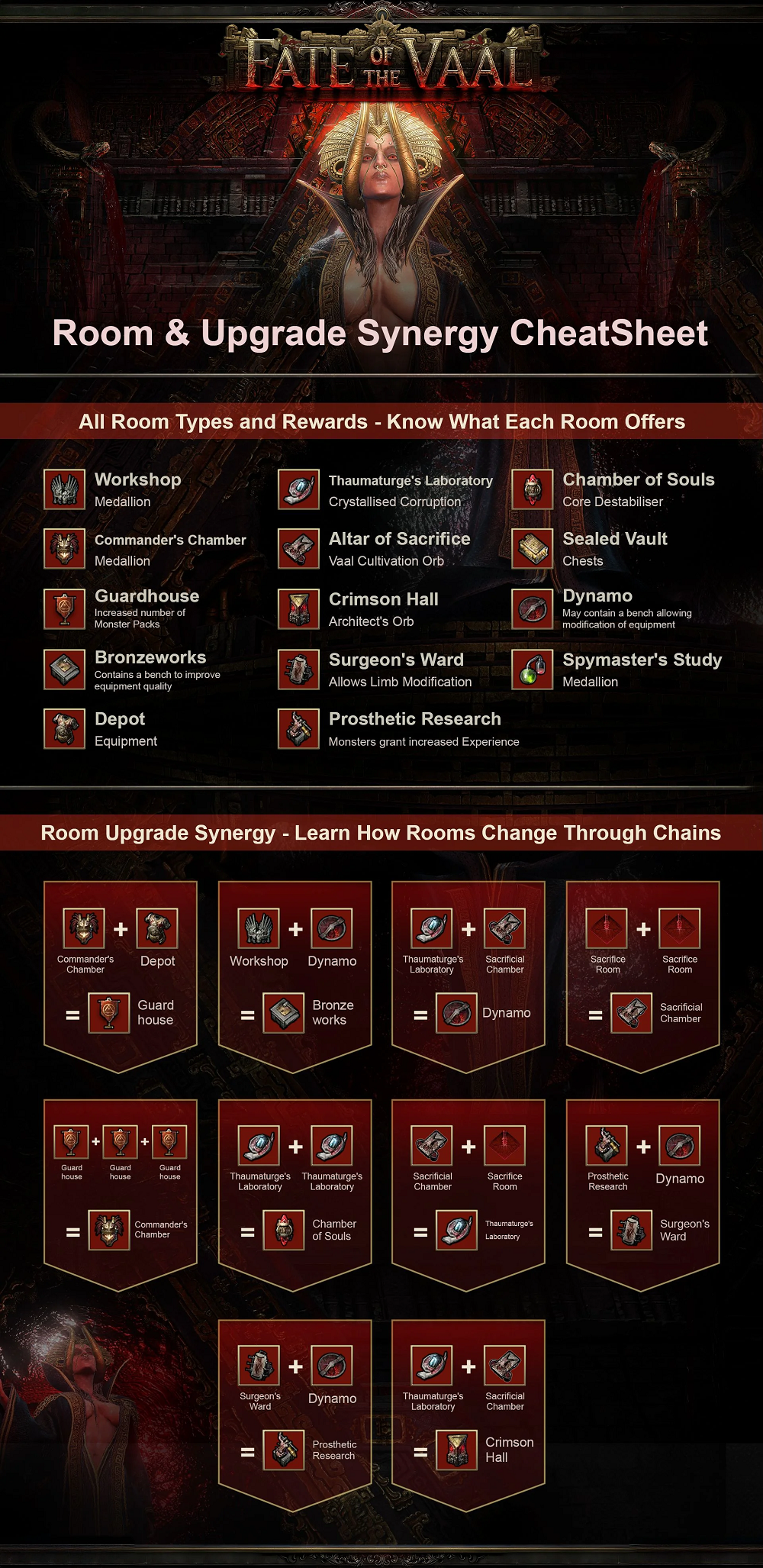
While it’s tempting to copy a proven layout, random room offerings mean you’ll need to adapt as you go. Use planners as a reference, but be ready to improvise based on what rooms are available each cycle. Focus on maintaining your snake and balancing loot multipliers, rather than seeking a perfect one-to-one replica.
Lock medallions are your best defense. At the end of every run, protect the end of your chain with a lock. This prevents any rooms in the middle from being deleted, so long as the chain isn’t connected elsewhere. Always prioritize locking your Spymaster chain, especially early on when locks are scarce. Place expendable or less valuable rooms in the center or isolated squares, so deletions target them rather than your main chain.




 items
items
 Order
Order Sell
Sell Live chat


